
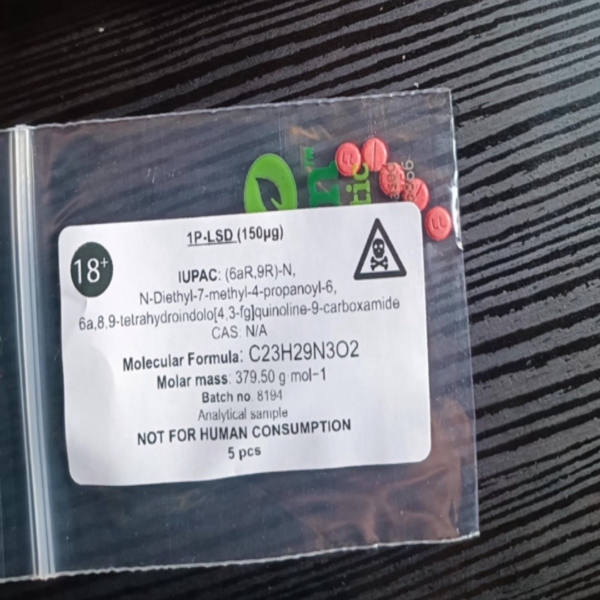
1P-LSD Pellet 150mcg


Price range: $ 100,00 through $ 2.500,00
1P-LSD, also referred to as 1-propionyl-LSD or 1-propionyl-lysergic acid diethylamide, is a structural analog of lysergic acid diethylamide (LSD). It belongs to the lysergamide class of compounds and is characterized by the presence of a propionyl group attached to the indole nitrogen.
This compound shares close structural similarities with LSD, which informs much of its current classification within psychedelic research discussions.
S1P-LSD Pellet 150mcg is a lysergamide compound with a propionyl group attached to the indole nitrogen of the ergoline structure. As a result, it closely resembles lysergic acid diethylamide (LSD) and related analogs such as ALD-52. The compound has a molecular formula of C₂₃H₂₉N₃O₂ and a molecular mass of 379.46 g/mol.
Structural Chemistry
The structure features a polycyclic ergoline backbone. Specifically, it combines a hexahydroindole system with a quinoline structure. At carbon-9, the N,N-diethylamide group remains intact, which preserves the core lysergamide framework.
In addition, the propionyl group modifies the indole nitrogen. Therefore, the compound maintains strong structural similarity to LSD while introducing a distinct functional variation.
Pharmacological Activity
1P-LSD Pellet 150mcg interacts with serotonergic systems, especially the 5-HT2A receptor. This receptor plays a key role in perception and cognition. As a result, receptor activation leads to changes in sensory processing and mental states.
Moreover, analytical studies show that 1P-LSD can convert to LSD under certain conditions. LC-MS analysis confirms this transformation in human serum. Therefore, the compound likely acts as a prodrug while also interacting directly with serotonin receptors.
Reported Effects Profile
Reported effects follow patterns seen in related lysergamides. However, intensity and variation depend on multiple factors.
Physical effects include stimulation, pupil dilation, increased heart rate, and enhanced tactile perception. In some cases, users report mild nausea.
Cognitive effects include thought acceleration, altered time perception, and stronger conceptual thinking. In addition, immersive mental states and thought loops may occur, especially at higher levels.
Sensory effects include perceptual distortions, auditory enhancement, and intensified sensory input. As a result, perception often becomes more vivid and layered.
Scientific Context
Current understanding remains limited. Most data comes from structural analysis, receptor studies, and observational reports. Therefore, conclusions rely on indirect evidence rather than controlled clinical research.
| Qty | 10xPellets, 25xPellets, 50xPellets, 100xPellets, 250xPellets, 500xPellets, 1000xPellets |
|---|
Be the first to review “1P-LSD Pellet 150mcg”
Related products

Buy LSD




Buy LSD
Reviews
There are no reviews yet.